The best exploration games are built on a specific psychological loop. You enter an unknown environment. The visual design is layered: obvious features in the foreground, partially revealed zones in the middle distance, and suggestions of something else further in. You move toward what interests you. You discover something unexpected. The discovery rewards you and immediately opens new vectors for further exploration. The loop restarts. You keep playing.
Game designers have been refining this loop for decades because it maps directly onto something the human brain finds intrinsically rewarding: the experience of moving through a complex environment and extracting information that was previously hidden. What most game designers probably don’t think about often enough is that this mechanic was not invented by the games industry. It was borrowed from reality. And reality runs the original version in a few places with a quality that no polygon budget has yet matched.
Belize’s section of the Mesoamerican Barrier Reef, the second-largest reef system on earth, is one of those places. Here are eight reasons why the snorkeling experience in Belize runs on the same mechanics as the games you play, and why the real version is worth experiencing.
1. The Great Blue Hole Is the Most Iconic Rare Spawn in the Natural World
In open-world games, a rare spawn is a location or encounter that requires specific conditions to access, offers a visual experience unavailable anywhere else in the game world, and delivers a sense of discovery that standard content can’t replicate. Players plan routes around rare spawns. They talk about them. The anticipation of reaching one is part of what sustains engagement across long play sessions.
The Great Blue Hole, a submarine sinkhole 70 kilometres off the Belize coast, is the natural world’s rare spawn. It is 300 metres across and 125 metres deep, a near-perfect circle of dark blue in the pale turquoise shallows of Lighthouse Reef Atoll. From the surface it looks like a loading screen for a different biome: the water colour changes abruptly at the edge of the hole from turquoise to deep indigo, and the transition from reef flat to vertical wall dropping into darkness happens within a few metres of swimming. Jacques Cousteau rated it one of the top five scuba diving sites in the world in 1971. The aerial view, now available on every satellite map application, shows why: the hole looks precisely like something a game designer placed on a map to make players leave the main quest and go investigate.
2. The Reef Biome System Has the Same Layered Structure as a Well-Designed Game Map
The Mesoamerican Barrier Reef runs 900 kilometres from the Yucatan Peninsula to Honduras, and the Belizean section includes multiple distinct reef environments within reachable distance of the mainland: fringing reefs close to the shore, barrier reef sections further out, and the three offshore atolls, Turneffe, Lighthouse, and Glover’s, each with their own ecological character.
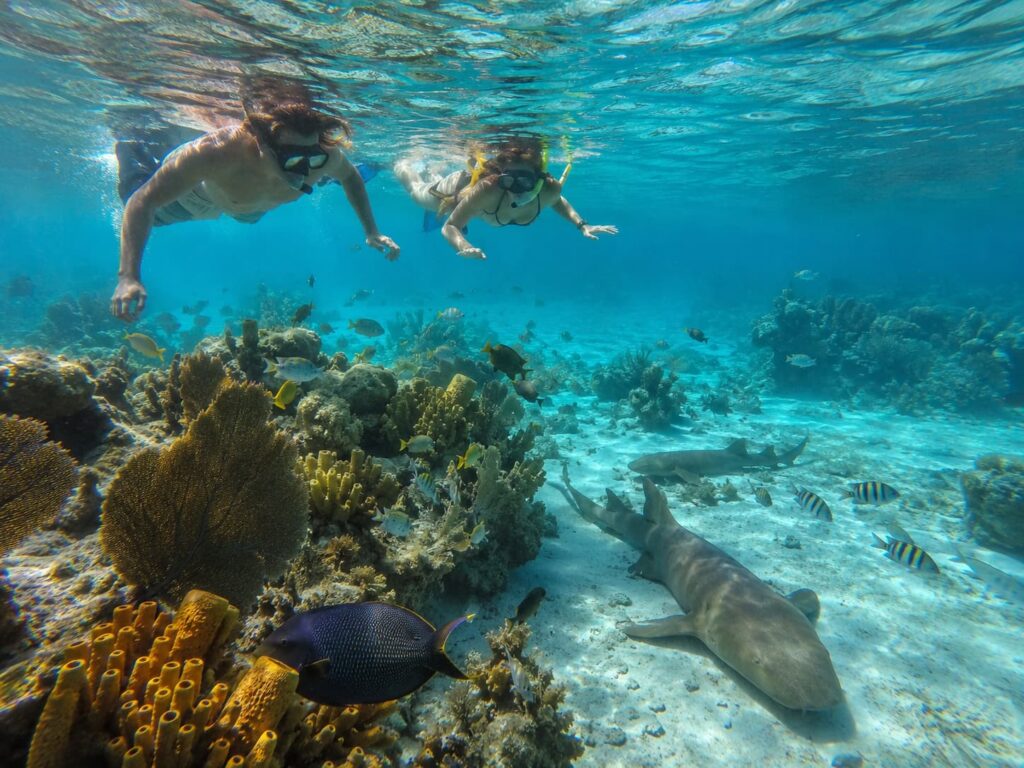
Each zone has a different species composition, different depth profile, and different visual quality. The shallow patch reefs close to the cayes have dense coral coverage and high fish density, accessible to any snorkeler. The barrier reef wall, where the reef edge drops from 5 metres to over 30 metres, produces the wall diving that draws specialists. The atolls sit further offshore on the continental shelf edge and have the clearest water and the largest pelagic species. This is exactly the zone architecture that the types of NFT games with open-world exploration components use: accessible starter zones with high activity density, mid-range zones requiring more investment to reach, and deep zones that reward committed players with encounters unavailable closer in.
3. Species Identification Is a Real-World Version of the Collectible Mechanic
The collectible mechanic in blockchain games, owning a unique digital asset with specific attributes and rarity tiers, works because the human brain finds categorisation and collection intrinsically satisfying. The satisfaction of completing a set, of acquiring a rare variant, of knowing the specific attributes of each item in your collection, is consistent across game genres and age groups.
Snorkeling on the Belize reef runs the same mechanic on actual biodiversity. The reef supports over 500 fish species and more than 100 coral species, each with distinct visual characteristics, behavioural patterns, and habitat preferences. A snorkeler who pays attention builds a mental collection across a session: the queen angelfish with its blue-ringed yellow crown, the spotted drum juvenile with its dramatically elongated dorsal fin, the cleaning station where small wrasse pick parasites from larger fish that hold still to allow it. Each new species identified is a discovery event with the same neurological signature as a rare drop in a play-to-earn game. The collection is not tokenised. It is more durable than that.
4. The Nurse Shark Encounter Is the Boss Fight That Everyone Remembers
Every good game has a boss encounter that the player anticipates, prepares for mentally, and talks about afterward. The encounter raises the stakes, changes the emotional register of the session, and provides a reference point around which the rest of the experience is organised. In Belize’s shallow reef areas, the nurse shark fills this role with a precision that no game designer could have intended.
Nurse sharks are non-aggressive bottom dwellers that rest in groups under coral heads in the shallows during the day, visible to snorkelers willing to look. The first time you float above a group of three or four nurse sharks resting on the sand in two metres of water, the experience organises itself around that moment in the same way that a significant boss encounter does in a well-designed game session. The context before it is prologue. The context after it is aftermath. The encounter itself is the content that everything else supports. Except that this one is a real animal in a real ocean, and the feeling that produces is not something a game has yet replicated.
h2 5. The Hidden Cave and Tunnel Systems Are the Secret Areas of the Reef
Every exploration game worth playing has secret areas: zones accessible only through non-obvious entry points that reward players who look carefully at the environment rather than moving through it on the main path. The reef equivalent is its cave and tunnel system, accessible at multiple sites around the Belizean cayes where the coral and limestone substrate has been eroded into passages large enough to swim through.
The experience of moving through an underwater tunnel in clear water, with the reef ecosystem visible through cracks and openings in the coral ceiling above, is one of those physical experiences that produces the specific combination of mild anxiety and high reward that the best game moments generate. The light changes in the tunnel. The sound changes. The spatial relationship between your body and the environment is different from open water. You emerge on the other side into a different section of the reef. The game design term for this is a transition zone, and the reef system runs them constantly without any developer having scripted the sequence.
6. Guided Snorkel Tours Navigate the Reef’s Complexity the Way Good Guides Navigate a Game World
The Belizean reef system covers thousands of square kilometres of water, and the specific sites with the best coral coverage, the most species diversity, and the clearest water conditions on any given day require local knowledge to find efficiently. A visitor arriving at San Pedro or Placencia with a mask and fins and no guide might spend a full day snorkeling in accessible but unremarkable sections when an hour’s boat ride in the right direction would reach something entirely different.
Operators like Belize Snorkeling Tours run guided excursions to the barrier reef, the Blue Hole, and the offshore atolls, with guides who know which sites have the best visibility on a given tidal and weather combination, where the nurse sharks are currently resting, and which time of day produces the best light conditions for the specific sites on the itinerary. For visitors who want to experience the full range of what the reef offers rather than the fraction accessible from shore, a guided approach covers more of the map in less time, which is the same value proposition that a good in-game guide or walkthrough provides without making the experience feel less like discovery.
7. The Reef’s Economy of Clean Water Parallels the Resource Management Layer in Blockchain Games
Play-to-earn games typically have a resource management layer underneath the exploration and combat mechanics: scarce inputs that must be managed carefully to sustain participation in the game economy. Belize’s reef has its own resource management layer, and it is one of the more instructive in the natural world: the health of the coral depends on water quality, which depends on land use practices on the adjacent mainland, which depends on agricultural and development policy in a country where economic pressures frequently conflict with conservation priorities.
The Belize Barrier Reef Reserve System, a UNESCO World Heritage Site, was removed from the list of endangered heritage sites in 2018 after the Belizean government reversed a policy that would have allowed offshore oil exploration within the reef zone. The decision was contested, economically costly in the short term, and ultimately made on the basis that the reef’s value as a functioning ecosystem exceeded its value as a resource extraction zone. The parallel to how blockchain game economies balance token emission, player extraction, and long-term ecosystem health is not exact, but it is closer than it might initially appear. As the mechanics covered in Axie Infinity’s economic model illustrate, the long-term viability of any token economy depends on the same basic insight: extraction without reinvestment depletes the system that makes the extraction valuable in the first place.
8. The Real World Has No Server Maintenance Windows
NFT games go down for server maintenance. Blockchain networks experience congestion. Smart contract bugs require patch cycles. The digital environments that play-to-earn games create are impressive but they exist on infrastructure that is subject to failure, modification by the developers, and eventual deprecation when the player base moves on to the next release.
The Belizean reef has been running continuously for approximately 10,000 years since the post-glacial sea level rise that gave it its current form, and the underlying limestone structures go back considerably further than that. The nurse sharks were there before anyone thought to build a game around collecting digital creatures. The coral formations that took decades to grow to their current size will still be there, conditions permitting, long after the current generation of blockchain games has been replaced by whatever comes next. There is something worth considering in that comparison, not as a criticism of games but as a reminder that the discovery loop the best games are built on is borrowed from a world that runs it at a scale and fidelity that no server farm currently supports. The Belize reef is worth visiting before the comparison gets too comfortable.
A Final Thought
The best experiences in games and in travel share the same quality: they put you somewhere you have never been and give you the tools to make sense of it on your own terms. The reef does not hand you a quest marker. It does not tell you where the nurse sharks are or which tunnel leads to the better coral section. It just runs the environment at full resolution and lets you find what you find.
That is a different kind of experience from a guided game world, and it produces a different kind of memory. The things you discover yourself, in games and in the ocean, sit differently in the brain than the things you are directed toward. Belize’s reef gives you a world to discover at a scale that no game has matched.
Log off for a week. Go find the nurse sharks. The blockchain will still be there when you get back.